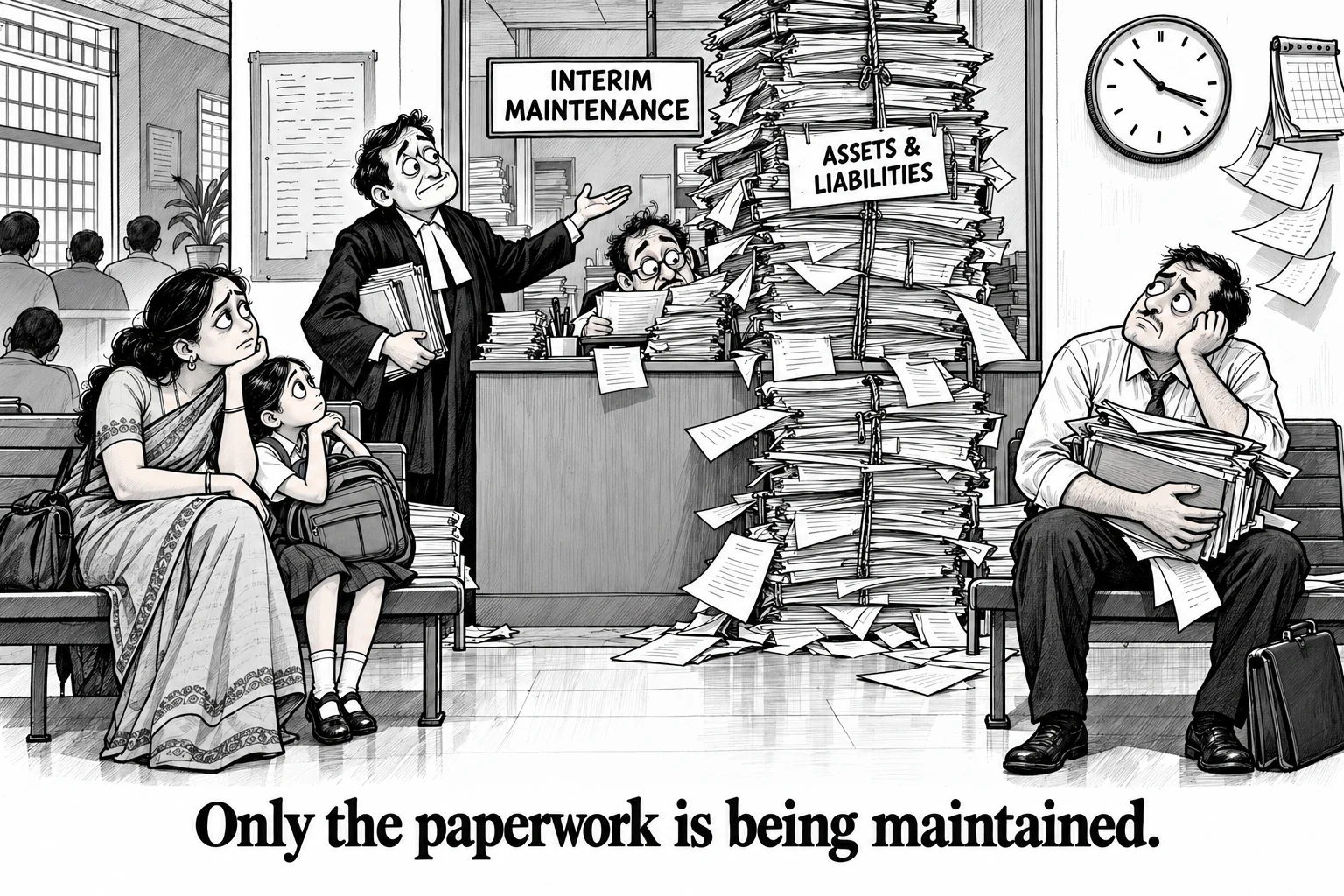
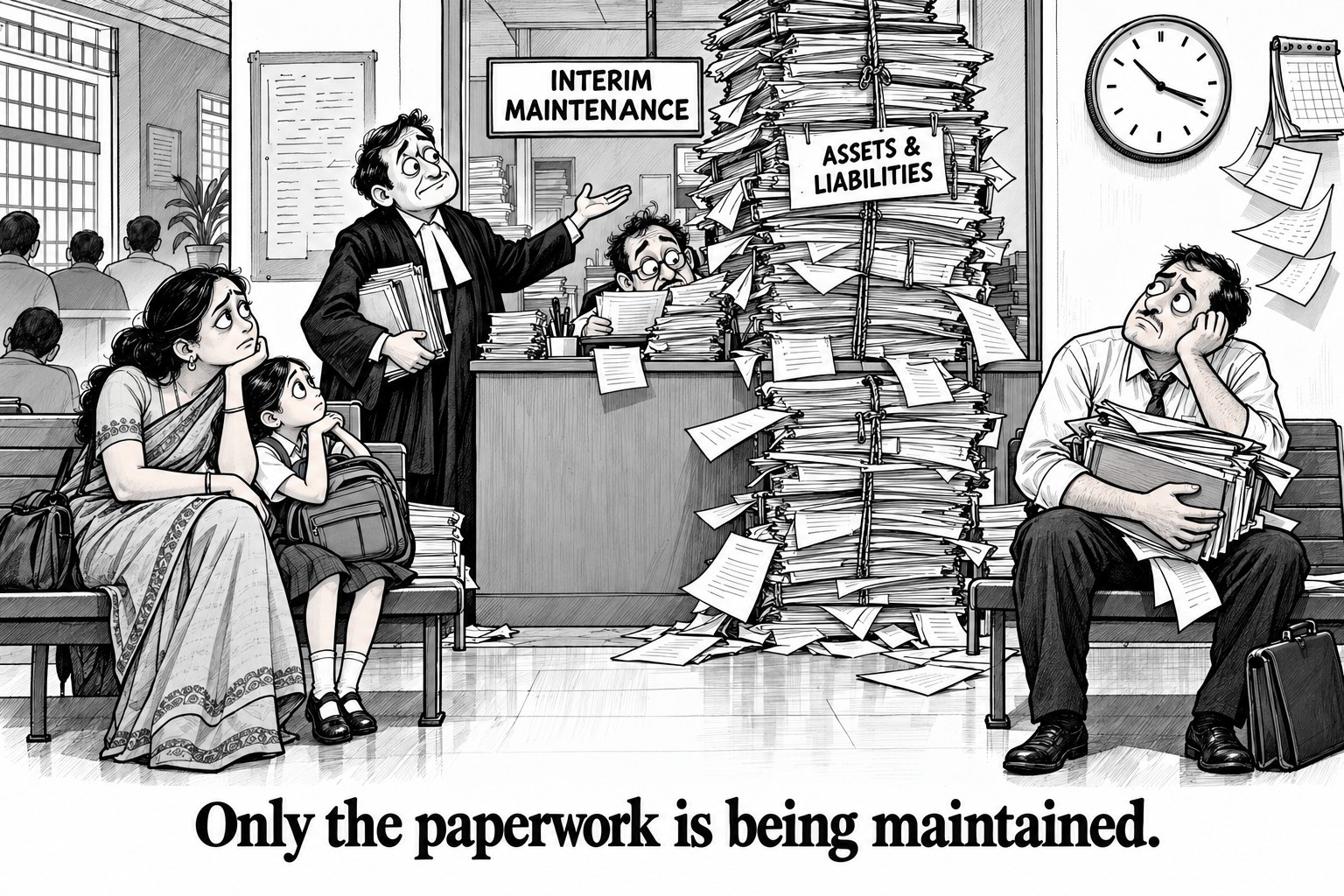
Maintenance law gives a dependent spouse three different reliefs at three different stages. The disclosure regime in Rajnesh v. Neha made the middle stage fairer, but often much slower. The Delhi High Court has now explained how ad interim maintenance fills the gap that delay leaves behind.
The months nobody counts
A woman leaves her matrimonial home, sometimes with a child and a bag, sometimes with less. She files for maintenance and an application for interim maintenance. Then the questions begin: who pays the rent, the school fees, the doctor, the lawyer, while the court decides?
The law's answer is interim maintenance, and Parliament wanted it quick. The provisos to Section 125 of the old Code of Criminal Procedure, now Section 144 of the Bharatiya Nagarik Suraksha Sanhita, 2023, ask that an interim maintenance application be decided, as far as possible, within sixty days of notice. Section 24 of the Hindu Marriage Act carries a similar sixty-day direction.
In the district courts of Delhi and western Uttar Pradesh, the reality is often different. Interim maintenance can take anywhere from one to three years to decide. Yes, even in Delhi, where the High Court has written more on this subject than most. For all that time, the person the law set out to protect is told to wait.
This article explains the three kinds of maintenance a court can order, why the middle one now takes so long, and why ad interim maintenance is not a technicality but a lifeline.
Three stages, three different questions
All three are maintenance, but each answers a different question at a different point in the case. Ad interim maintenance asks: what does she need to survive this month? Interim maintenance asks: what is fair while the case lasts? Final maintenance asks: what is right after the evidence is in?
Scroll the table sideways on smaller screens.
| Comparison | Ad interim maintenance | Interim maintenance | Final maintenance |
|---|---|---|---|
| When | At the threshold, before the interim application is decided | During the case, after pleadings and disclosure affidavits | At the end, after evidence |
| What the court relies on | Admitted income, a salary slip, a party's statement in court, or prima facie material | Pleadings and both Affidavits of Disclosure of Assets and Liabilities | Evidence tested in cross-examination |
| Nature | Tentative, discretionary, a stop-gap | Reasoned, but still provisional | Adjudication on merits |
| Source | Judge-made, chiefly through Delhi High Court precedent | Statute: Section 144 BNSS (formerly Section 125 CrPC), Section 24 HMA, Section 23 DV Act | Statute: the same enactments |
| Payable from | The date of the order (Delhi High Court, 2025) | Ordinarily the date of the application (Rajnesh v. Neha) | Ordinarily the date of the application (Rajnesh v. Neha) |
| Adjusted later? | Yes, against interim maintenance | Yes, against final maintenance | Subject to alteration on changed circumstances |
The Delhi High Court puts the difference simply. Interim relief is granted after hearing both parties and considering their pleadings. Ad interim relief is granted at the preliminary stage, to alleviate urgent hardship, before the interim claim can be examined properly. Both are temporary; what separates them is the stage, the extent of hearing, and the depth of the court's prima facie view.
The Domestic Violence Act already speaks this language. Section 23 allows a Magistrate to pass interim orders, and even ex parte orders on the aggrieved woman's affidavit, where the application prima facie discloses domestic violence. Under Section 144 BNSS and Section 24 HMA, ad interim relief has grown from case law rather than express text.
What Rajnesh v. Neha set out to fix
Rajnesh v. Neha, (2021) 2 SCC 324, decided on 4 November 2020, was written with the best of intentions. Before it, interim maintenance was largely fixed on pleadings and guesswork. As the Supreme Court later summarised, one side tended to exaggerate needs and the other to conceal income, and both filed scanty material.
The Court's answer was disclosure. In paragraph 72 it required both parties, in all maintenance proceedings across the country, to file a sworn Affidavit of Disclosure of Assets and Liabilities in a prescribed format. The key directions are these:
- The claimant files a concise application with her affidavit.
- The respondent files his reply and affidavit within a maximum of four weeks, with no more than two opportunities.
- Wilful, contumacious delay may lead to his defence being struck off; otherwise, the court may decide on the claimant's affidavit and pleadings.
- Disputes about disclosure can be tested through interrogatories and production under Order XI CPC, and the court can draw on Section 106 of the Evidence Act, because income is within the personal knowledge of the person who earns it.
- The court must endeavour to decide interim maintenance within four to six months after the Affidavits of Disclosure have been filed.
The Court also directed that maintenance ordinarily be paid from the date of the application, so that delay would not cost the claimant. In Aditi v. Jitesh Sharma, 2023 INSC 981, the Supreme Court found that trial courts were still deciding maintenance without these affidavits, and directed that Rajnesh be recirculated to judicial officers and judicial academies.
On paper, the scheme is fair to both sides. The difficulty lies in the phrase in bold.
How disclosure became a waiting room
The four-to-six-month clock in Rajnesh does not start when the claimant walks into court. It starts only once both affidavits are on record. Everything before that, and every dispute about what those affidavits contain, sits outside the clock.
Consider what the prescribed affidavit asks for. Bank statements of all accounts for the last three years. Income tax returns for the year before marriage, the year before separation and the year of filing. Rent, interest, dividends, shares, mutual funds, fixed deposits, capital gains. Loans taken and given, jewellery, property transferred during the marriage, business balance sheets, foreign income. None of this is unreasonable. Almost none of it is quick.
In practice, the delays come from familiar places:
- Gathering records takes time. Banks issue old statements slowly. Accounts are dormant, joint, or held through a family business. A woman who never handled the household's finances may not know which banks to approach.
- Concealment invites contest. An undisclosed account, a recent large transfer, or a salary slip that does not match the bank credits leads to objections, applications for production, interrogatories and supplementary affidavits. Each is legitimate; together they swell the file.
- Both sides conceal. A respondent understates his income. A claimant sometimes understates her own earnings or family support. Each side's omissions become the other's ground for adjournment.
- Parallel forums multiply the work. The same couple may be litigating under the Domestic Violence Act, Section 144 BNSS and the Hindu Marriage Act, with disclosure and objections in each.
- Court calendars are full. A detailed scrutiny of three years of statements cannot be done in the few minutes a crowded list allows.
I have seen the toll this takes. The claimant moves back to her parents' house and waits, often embarrassed to ask them for money at an age when she expected to be independent. Her child's needs do not wait for affidavits. Meanwhile, the respondent, who may be honest and of modest means, spends months compiling paperwork and paying for hearings. Neither person is well served.
The irony is plain. A judgment designed to make interim maintenance fair has, in many courtrooms, made it slower. The more thorough the inquiry, the longer the person in need goes without anything at all.
The Delhi High Court's answer: relief while the inquiry runs
Ad interim maintenance is not new in Delhi. In Rajesh Chaudhary v. Nirmala Chaudhary, (2006) 86 DRJ 61, the High Court suggested that a respondent's admitted liability be ordered paid within weeks of notice, while the larger dispute continued. The Kusum Sharma v. Mahinder Kumar Sharma series, from 2014 to 2020, built the Delhi format of income affidavits and kept a standing direction: if deciding maintenance takes time and the delay causes hardship, grant ad interim maintenance on the respondent's admitted income.
After Rajnesh, a question arose. If the Supreme Court has prescribed a full disclosure process for interim maintenance, can a court pay anything before that process ends? Some respondents argued that ad interim orders now bypassed the Supreme Court's mandate.
In Naveen Kumar v. Kavita, CRL.REV.P.(MAT.) 172/2024, decided on 1 July 2025, the Delhi High Court answered that question clearly:
- Rajnesh does not govern ad interim maintenance. The judgment deals with interim and final maintenance and makes no specific reference to ad interim relief. The two terms are not interchangeable in purpose or procedure.
- The difference lies in the delay. The Supreme Court expected interim applications to take four to six months. It is in that window, the Court said, that ad interim maintenance assumes its true significance. It is to the interim application what interim maintenance is to the main petition.
- The Kusum Sharma procedure continues. Because the Supreme Court has not disturbed it, the Delhi line of authority still governs ad interim relief.
- Admitted income is enough to begin. Where a salary slip or similar admitted document is on record, or the respondent's own affidavit admits some income, the court may grant ad interim maintenance without awaiting the outcome of the interim application.
- Delay and defective disclosure are no shield. If a party delays filing, files a deficient affidavit, or withholds documents, and that causes hardship, the court may fix an ad interim amount after hearing both sides.
- No separate application is required. The court may grant ad interim maintenance on the material before it.
Three weeks later, in Amit Joshi v. Diksha, CRL.REV.P. 392/2024, decided on 21 July 2025, the High Court applied these principles. A Family Court had ordered ₹50,000 a month on the respondent's first appearance, relying on his own statement in court that he earned ₹3.5 to 4 lakh a month abroad. The High Court upheld it. The amount was a fraction of his admitted income, he had been heard, and being qualified to earn is not the same as actually earning. Tellingly, the High Court also asked the Family Court to try to decide the interim application within six months, though it had been filed in November 2023.
That last direction says more than any statistic could. The interim application was still pending more than a year and a half later. Without the ad interim order, the claimant would have received nothing in that time.
What ad interim maintenance is not
Ad interim maintenance is a lifeline, not a shortcut around Rajnesh. The Delhi High Court was careful to mark its limits, and claimants should know them.
- It is not routine. It is discretionary and meant for urgent hardship, especially where the interim application will take time. Where no urgency is shown, the court should instead decide the interim application quickly.
- It needs some footing. The Delhi cases contemplate admitted income, documents on record, or a hearing of both sides. An order passed without hearing the respondent and without any material on his income was not what the Kusum Sharma line permitted.
- It runs from the date of the order. In Naveen Kumar, the High Court modified a Family Court order that made ad interim maintenance payable from the date of the application. Backdating a tentative order, it held, would blur the line between ad interim and interim relief. Arrears from the date of application belong to the interim and final stages.
- It is provisional. It is adjusted when interim maintenance is fixed, and neither side's case is decided by it.
The third point has a practical lesson. Because ad interim maintenance runs only from the order, every hearing at which it is not sought is a month the claimant cannot recover at the ad interim stage. The request should be made early, ideally at the first effective hearing after appearance.
Practical notes for both sides
For the person seeking maintenance
- File your Affidavit of Disclosure with the application, as Rajnesh requires. A complete affidavit from you strengthens a request for urgency.
- Put any admitted income of the respondent on record at once: salary slips, appointment letters, Form 16, income tax returns, or his own statements in other proceedings.
- Ask for ad interim maintenance expressly and early, explaining the hardship: rent, school fees, medical needs, dependence on family.
- Be accurate about your own work and support. Overstatement invites the very contest that causes delay.
For the person asked to pay
- File a complete affidavit within the four weeks Rajnesh allows. Delay and gaps are now grounds for ad interim relief, not reasons to postpone it.
- If the claim is excessive, say so with documents. A respondent who discloses fully is far better placed to resist an inflated figure.
- Pay what is ordered while challenging it. Non-payment risks coercive steps and rarely helps the case.
For courts and the Bar
- Read Rajnesh and the Delhi ad interim cases together, as complements. Full disclosure decides interim maintenance; ad interim maintenance covers the months that disclosure takes.
- Where an affidavit is late or patently deficient, that is precisely the situation in which the Delhi High Court has said ad interim relief may follow.
Conclusion: fairness and speed are not rivals
Rajnesh v. Neha was right to insist that maintenance be fixed on facts rather than guesses. But a process that takes one to three years to reach a fair figure can be unfair in a different way: to the person who must live through those years.
Ad interim maintenance resolves that tension without abandoning disclosure. The court pays attention to what is already admitted, gives the claimant enough to stand on, and lets the full inquiry run its course. The Delhi High Court's 2025 decisions are binding on courts in Delhi and offer a well-reasoned guide to courts elsewhere, including in Uttar Pradesh.
Maintenance has never been charity. It exists to prevent destitution and to preserve dignity. A remedy meant to keep someone from hardship should not itself become a source of it.
Judgments referred to
- Naveen Kumar v. Kavita, CRL.REV.P.(MAT.) 172/2024, Delhi High Court, 1 July 2025
- Amit Joshi v. Diksha, CRL.REV.P. 392/2024, Delhi High Court, 21 July 2025
- Aditi v. Jitesh Sharma, 2023 INSC 981, Supreme Court of India, 6 November 2023 (extracts the Rajnesh v. Neha guidelines)
- Rajnesh v. Neha, (2021) 2 SCC 324, Supreme Court of India, 4 November 2020
The author is an advocate practising in the NCR, before the High Courts of Delhi and Allahabad, and before the Supreme Court of India. This article is for general information and is not legal advice.