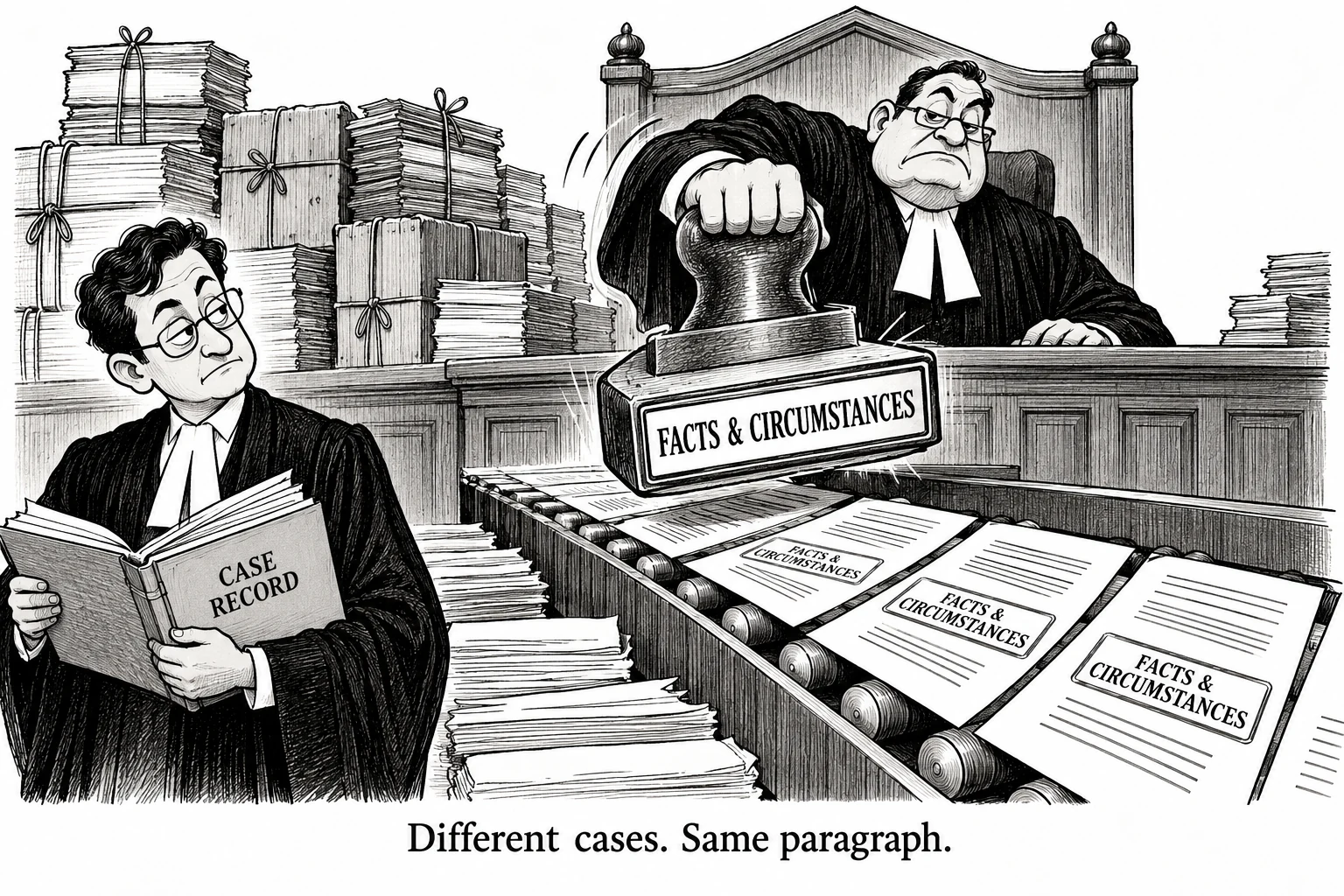
A bail order is a judicial decision. It has to show that the judge actually looked at the case.
Anyone who has followed a bail application through the High Court, whether as counsel, as a complainant or as an accused, will know the paragraph. The order sets out what counsel for the accused argued. It notes that the State "opposed". Then it ends with something like this:
"Considering the contentions put-forth by the counsel for the petitioner and taking into account the facts and circumstances of the case and without expressing opinion on the merits of the case, this court deems it just and proper to enlarge the petitioner on bail."
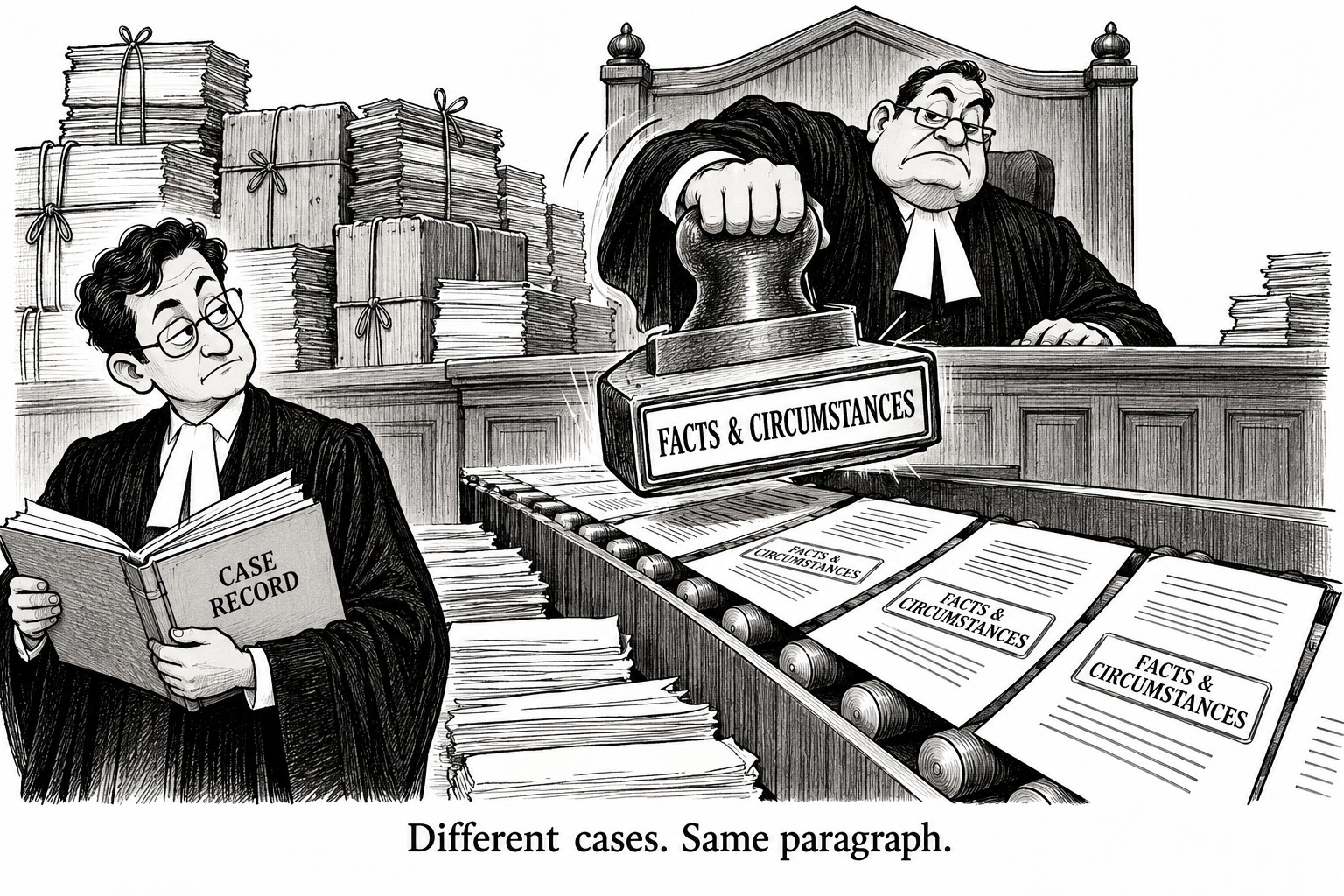
The sentence sounds judicial. It names the contentions, the facts and the circumstances, and it is careful about the merits. But read it again and ask what it tells you: which facts, which circumstances, and why they point towards bail. It answers none of those questions. It could be pasted into any bail order in any case, and that is the problem.
What Mahipal said about the formula
The paragraph quoted above is not invented. It is the whole of the reasoning in a High Court order that granted bail in a murder case. In Mahipal v. Rajesh Kumar (2020) 2 SCC 118, the Supreme Court reproduced it and set the order aside. Writing for the Bench, Justice D.Y. Chandrachud said:
"Merely recording 'having perused the record' and 'on the facts and circumstances of the case' does not sub-serve the purpose of a reasoned judicial order."
The quotation marks around those phrases make the point without the Court needing to raise its voice. These are words that only look like reasons. The Court then explained why reasons matter so much in bail:
"It is a fundamental premise of open justice… that factors which have weighed in the mind of the judge in the rejection or the grant of bail are recorded in the order passed… Questions of the grant of bail concern both liberty of individuals undergoing criminal prosecution as well as the interests of the criminal justice system in ensuring that those who commit crimes are not afforded the opportunity to obstruct justice. Judges are duty bound to explain the basis on which they have arrived at a conclusion."
Two consequences follow, and both are stated in the judgment:
- No reasons, presumed non-application of mind. "Where an order refusing or granting bail does not furnish the reasons that inform the decision, there is a presumption of the non-application of mind which may require the intervention of this Court."
- A higher burden after a refusal. "Where an earlier application for bail has been rejected, there is a higher burden on the appellate court to furnish specific reasons as to why bail should be granted."
The Court drew on its earlier ruling in Kalyan Chandra Sarkar v. Rajesh Ranjan (2004) 7 SCC 528. A detailed examination of evidence is not needed at the bail stage, it said, but "there is a need to indicate in such orders reasons for prima facie concluding why bail was being granted particularly where the accused is charged of having committed a serious offence".
Note that the rule applies both ways. A refusal of bail written in the same formula is just as defective as a grant.
Does the court have to examine the evidence?
The usual objection to all this is practical. A bail court is not a trial court. It cannot weigh witnesses, test recoveries or decide which version is true. If it is asked to look into case diaries and recoveries, isn't it being asked to hold a trial before the trial?
The Supreme Court's answer is that there is a middle ground, and that the formula order falls short of it.
What the court need not do. Mahipal is clear that "the court is not required to enter into a detailed analysis of the evidence on record to establish beyond reasonable doubt the commission of the crime by the accused. That is a matter for trial." A bail court does not decide guilt, does not resolve contradictions, and does not have to write a long judgment.
What the court must do. The same paragraph goes on: "the Court is required to examine whether there is a prima facie or reasonable ground to believe that the accused had committed the offence". That examination is made "on the basis of the evidentiary record". In Mahipal itself, the Supreme Court did not hold a trial. It simply looked at what the High Court had ignored: the post-mortem report, the eyewitness statement and the recoveries noted in the chargesheet. It held that the order "fails to notice material facts and shows a non-application of mind to the seriousness of the crime".
X v. State of Uttar Pradesh, 2026 LiveLaw (SC) 36, decided on 9 January 2026 by Justices B.V. Nagarathna and R. Mahadevan, takes this further. The Allahabad High Court had granted bail in a case of grave sexual offences against a minor. The order did not notice that a chargesheet had already been filed. The Supreme Court set it aside and laid down the principle in paragraph 12:
"It is settled law that the mere filing of a chargesheet does not, by itself, preclude consideration of an application for bail. However, while assessing such an application, the Court is duty-bound to have due regard to the nature and gravity of the offence and the material collected during investigation."
The phrase "material collected during investigation" is the answer to our question. It means the statements recorded during investigation, the statement before the Magistrate, the medical and forensic reports, the recoveries and the chargesheet. In short, what is in the case diary. The court does not weigh that material as a trial judge would. But it must look at it, and its order must show that it did.
The Court described the High Court's failure in paragraph 13: "The omission to notice that the chargesheet had already been filed, coupled with the prima facie material emerging from the victim's statements renders the exercise of discretion by the High Court manifestly erroneous." And in paragraph 16 it stated the rule in a form that works in both directions:
"It is equally well settled that while bail is not to be refused mechanically, it must not be granted on irrelevant considerations or by ignoring material evidence. Where an order granting bail is founded on an incorrect appreciation of facts or suffers from material omissions… this Court is empowered to interfere."
Read together, the two judgments draw the line clearly. Evaluating the evidence is for the trial. Noticing it is the minimum a bail order requires.
What a reasoned bail order looks like
A reasoned order need not be long. A few sentences will do, as long as they are about this case. Whether you are an advocate drafting grounds or a family member reading an order for the first time, these are the questions to ask of it:
- Does it state the case as it now stands? If a chargesheet has been filed, the order should deal with the offences charged and the material collected, not just the allegations in the FIR. X v. State of U.P. turned on exactly this omission.
- Does it say what the prima facie material shows? One or two lines on the statements, the medical or forensic report and any recovery is enough. It need not say whether that material is true, only that the court has considered it.
- Does it deal with the prosecution's objections? Writing "the State opposed" only records an objection. Saying why the objection does not stand in the way of bail is what answers it.
- Does it address the factors that matter in this case? These include the gravity of the offence, the punishment it carries, any risk of the accused fleeing, and any risk of witnesses being threatened, particularly where a vulnerable victim lives nearby.
- Does it account for earlier refusals? If a lower court, or the same court, refused bail before, Mahipal requires specific reasons for granting it now. Something should have changed.
- Do its reasons fit the law? A reason must relate to the offence charged. Relying on the absence of a fact the offence does not require is not a reason at all.
An order that answers these questions is hard to overturn even when the offence is grave, and that is the point. Reasons protect a grant of bail as much as they protect the victim and the public. An order that answers none of them is open to challenge however sound its result may be.
Reflections
The Allahabad High Court hears more bail applications than almost any court in the country, and nobody expects a full judgment in each one. The formula paragraph is a response to that volume, and it is easy to see why it survives. But Mahipal and X v. State of U.P. make clear that volume does not change the duty. What a heavy docket justifies is a short order, not an empty one.
For advocates, the lesson is practical. Put the material before the court, whether that is the case diary extract, the statement before the Magistrate, the recovery memo or the earlier refusal, and ask the court to deal with it. If it does not, the omission is a ground of challenge in itself. For a complainant or an accused reading an order for the first time, the test is simpler: can you tell from the order why the judge decided as they did? If the only answer is "the facts and circumstances of the case", the Supreme Court has already said that is not enough.
Bail remains the rule, and liberty should not depend on how long an order is. But it should depend on whether the judge actually considered the case. In Mahipal's words, justice "should not only be done, but should manifestly and undoubtedly be seen to be done", and "the duty of judges to give reasoned decisions lies at the heart of this commitment".
The author is an advocate practising in the NCR, before the High Courts of Delhi and Allahabad, and before the Supreme Court of India. This article is for general information and is not legal advice.
Authorities: Mahipal v. Rajesh Kumar (2020) 2 SCC 118 · X v. State of Uttar Pradesh, Criminal Appeal No. 164 of 2026, 2026 LiveLaw (SC) 36 (9 January 2026) · Kalyan Chandra Sarkar v. Rajesh Ranjan (2004) 7 SCC 528